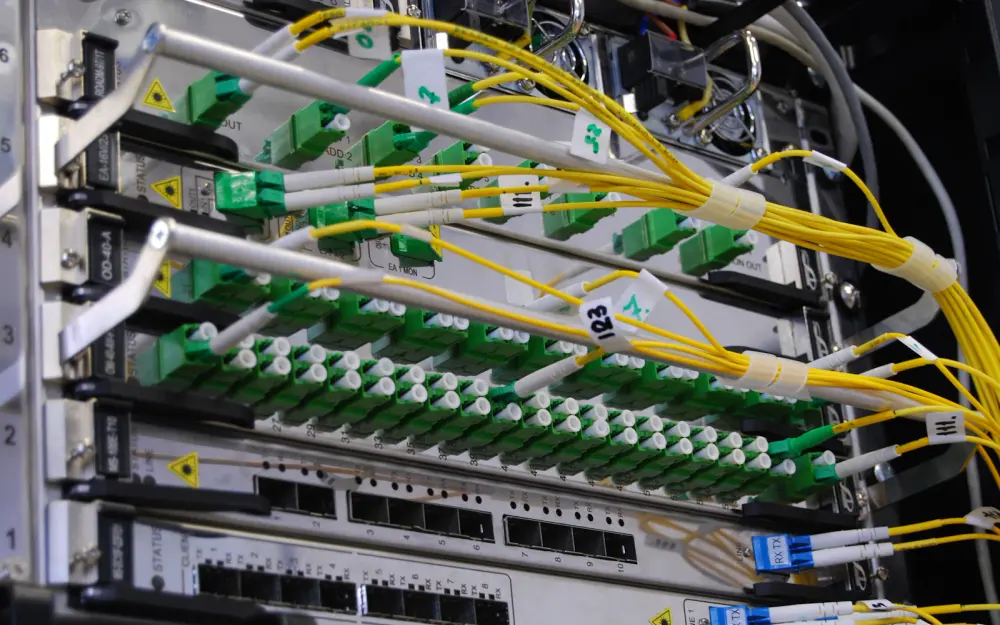
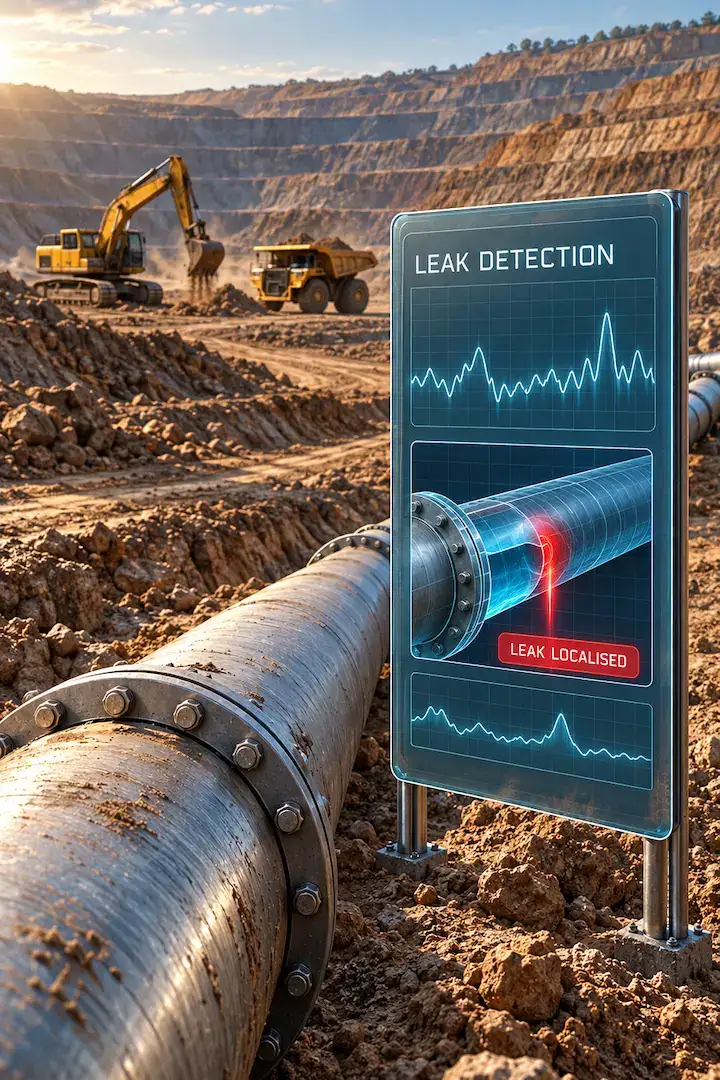
Our Fibre Optic Sensing (FOS) technologies transform a single optical cable into a powerful, multi-application monitoring network, delivering continuous, real-time insight across vast infrastructure.
Illustration: the time a reflection takes to return tells the interrogator where along the fibre it came from. Not measured data.
How it works
One Cable, Three Signals
A single optical cable laid along the pipeline becomes thousands of sensors. Light is launched into the fibre as a pulse and the light scattered back is analysed; position follows from the round-trip time. TLE combines Distributed Acoustic (DAS), Temperature (DTS) and Strain (DSS) sensing.
DASVibration
Distributed Acoustic Sensing
Leaks, digging and intrusion along the route
Listens along the whole cable, so vibration from a leak, a digger or someone on the right-of-way shows up at the position where it happened.
Reads
Vibration and acoustic energy at every point along the fibre
Based on
Rayleigh backscatter, using phase-sensitive optical time-domain reflectometry
On a pipeline
Third-party interference such as digging and vehicles, leak noise, right-of-way monitoring
Classification
Software, including machine learning, helps tell activities apart and reduce nuisance alarms
Live viewSimulated, not measured data
Distance along fibreTime, newest at topLeakDigging
Steady bandcontinuous noise at one position, such as a leak
Repeating burstsshort strikes at one position, such as digging
Diagonal streaka source moving along the route, such as a vehicle
DTSTemperature
Distributed Temperature Sensing
Leak and fire detection through temperature change
Reads temperature along the cable, so a hot or cold spot from escaping product or a fire appears at its position.
Reads
Temperature at every point along the fibre
Based on
Raman scattering: the ratio of Stokes to anti-Stokes light changes with temperature
On a pipeline
Leak and fire detection, and temperature profiling of process pipelines
Also used for
Thermal monitoring of power cables
Live viewSimulated, not measured data
Distance along fibreTemperatureAlarm
Linetemperature profile along the route
Peak or dipa local hot or cold spot
Dashed linean alarm threshold; crossing it raises an alarm
DSSStrain
Distributed Strain Sensing
Ground movement and pipe stress
Measures strain along the cable, so stretching from ground movement or stress in a pipe can be placed along the route.
Reads
Strain at every point along the fibre
Based on
Brillouin scattering: the Brillouin frequency shift is linearly related to strain and to temperature
On a pipeline
Ground movement and pipe stress
Also used for
Structural health monitoring and power cable strain
Live viewSimulated, not measured data
FrequencyStrained sectionFrequency shift
Ticksevenly spaced marks along the cable; stretching spreads them apart
Cyan peakthe Brillouin spectrum at the strained point
Dashed peakthe unstrained reference; the peak shifts as strain rises
The scattering types above are the basis commonly used for each measurement. Sensing range, spatial resolution and sensing resolution trade off against each other, so a system is specified for the route it will monitor.
Applications
Where It Is Used
Pipelines and right-of-way
Pipeline Leak & Third-Party Intrusion Detection
Right-of-Way (ROW) Security and Monitoring
Temperature Profiling for Process Pipelines
Third-party interference is a major cause of pipeline failures, and DAS on buried fibre beside a pipeline is a tool for detecting it.
The second edition of API RP 1175 adds the role of fibre-optic sensing to its framework for leak detection programs. See how it works with the computational methods.
Straight answers on how one optical cable becomes a monitoring network, and what DAS, DTS and DSS each measure.
What is fibre optic sensing?
Fibre optic sensing (FOS) turns a single optical cable into a multi-application monitoring network. Light is launched into the fibre as a pulse and the light scattered back is analysed, so a cable laid along a pipeline becomes thousands of sensors delivering continuous, real-time insight.
What is the difference between DAS, DTS and DSS?
Distributed acoustic sensing (DAS) reads vibration and acoustic energy, distributed temperature sensing (DTS) reads temperature, and distributed strain sensing (DSS) reads strain, each at every point along the fibre. TLE combines all three.
How does fibre optic sensing detect pipeline leaks and intrusion?
DAS listens along the whole cable, so vibration from a leak, a digger or someone on the right-of-way shows up at the position where it happened. DTS reads temperature, so a hot or cold spot from escaping product or a fire appears at its position. DSS places ground movement and pipe stress along the route.
How does the system know where an event happened?
Position follows from the round-trip time of the scattered light: the time a reflection takes to return tells the interrogator where along the fibre it came from.
Where is fibre optic sensing used?
Pipelines and right-of-way (leak and third-party intrusion detection, right-of-way security, temperature profiling for process pipelines), industrial sites (perimeter protection), power (thermal and strain monitoring of power cables) and structures and ground (structural health monitoring, seismic and vibration analysis).
Does fibre optic sensing need electronics in the field?
No. TLE fibre optic sensing needs minimal maintenance and no field electronics along the cable. It integrates with control systems and alarms, and uses AI-based event classification to help tell activities apart.
Does fibre optic sensing replace computational leak detection?
No. It adds a second, external layer along the whole route and sits alongside computational methods. The two are often combined, and TLE supplies both.