
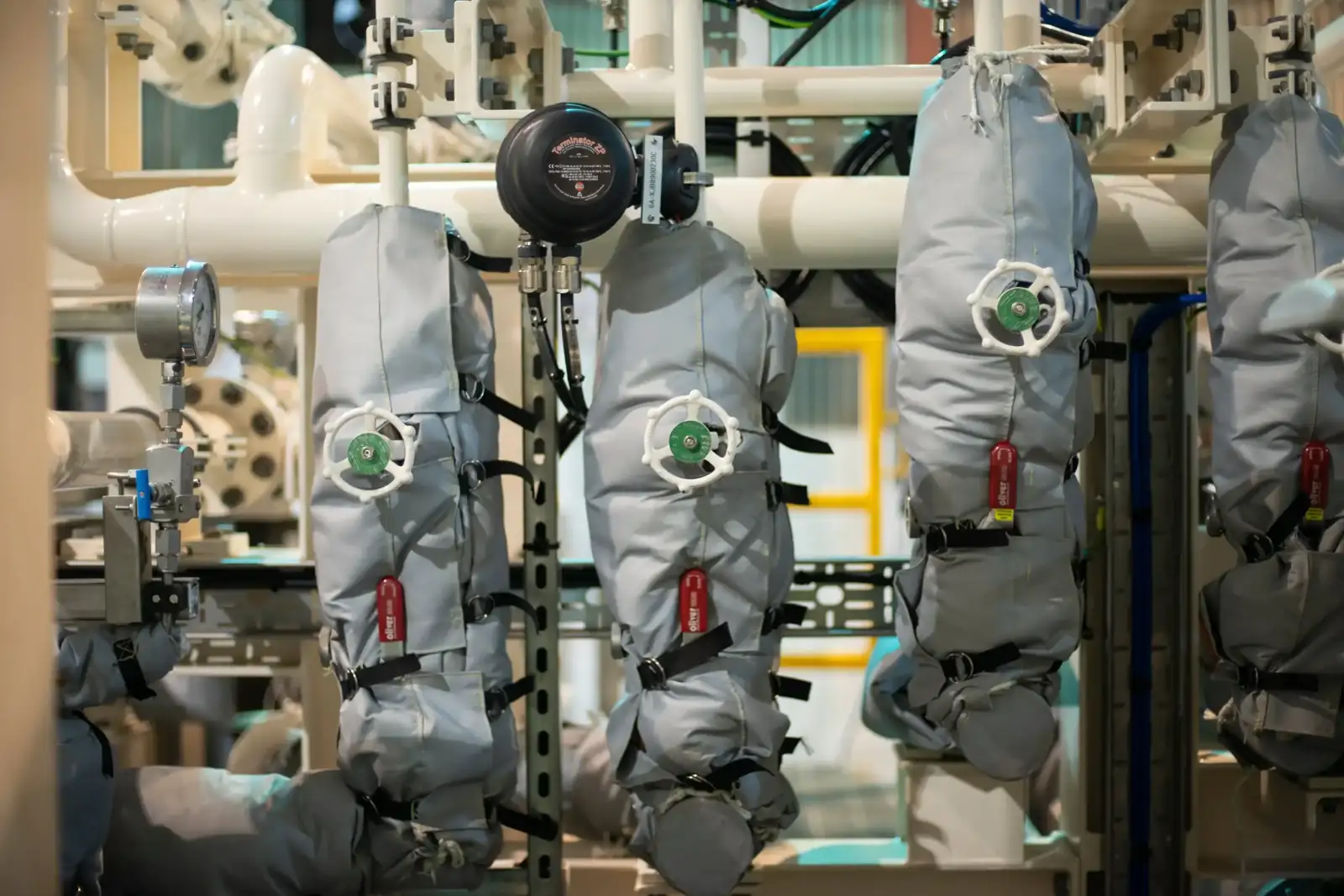
Pipeline Management Systems
One integrated platform to monitor, manage, analyze, optimize and improve the safe and efficient operation of pipeline networks carrying gas, oil, refined products and water.
- Inlet pressure
- 62.0 bar
- Flow
- 20.0 MSCMD
- Status
- Within limits
One Platform for the
Whole Pipeline Network
A Pipeline Management System (PMS) is an integrated software platform used to monitor, manage, analyze, optimize, and improve the safe and efficient operation of pipeline networks transporting natural gas, crude oil, refined petroleum products, water, and other fluids.
A PMS can integrate hydraulic simulation, real-time operational monitoring, leak detection, equipment monitoring, alarm management, and operational decision support into one platform.
The term PMS means different things depending on the vendor and project scope. In pipeline operations it often refers to a supervisory software platform, and its exact capabilities depend on the modules implemented.
Works with our remote terminal units, mission critical communication systems, leak detection systems and fibre optic sensing.
How the data reaches the operator
Field instruments measure operating conditions.
A PMS does not necessarily replace SCADA. It can operate as a higher-level analytical platform integrated with an existing SCADA system.
What a Comprehensive PMS
Can Include
Six functions make up a comprehensive system, and which of them a project receives depends on its scope and the modules implemented. Pick one to run a small simulation of it.
All figures in the demonstrations are illustrative, from a simulated 200 km gas line. They are not measured data.
Real-time pipeline monitoring
The system collects operational measurements from field instrumentation and control systems, then shows them as dashboards, trends, alarms and engineering displays.
Typical measurements
Hydraulic simulation and analysis
A PMS can calculate the hydraulic and thermodynamic behavior of a pipeline network, and use the results to determine whether a pipeline is operating within its design and operating limits.
- Inlet pressure
- –
- Delivery pressure
- –
- Pressure loss
- –
- Against limits
- –
Depending on its engineering capabilities, it can calculate
Gas and liquid pipelines
For natural gas pipelines, calculations may require real-gas equations of state, such as Peng–Robinson or Soave–Redlich–Kwong, depending on the application and the required accuracy.
For liquid pipelines, the model may need to account for viscosity, Reynolds number, friction-factor correlations, and the relevant fluid properties.
Leak detection and localization
A PMS may incorporate a Leak Detection System (LDS), or it may interface with a separate LDS. Start a simulated leak and watch the flow balance break.
White line: flow in. Cyan line: flow out.
- Leak alarm status
- Normal
- Estimated leak rate
- –
- Estimated leak location
- –
- Detection confidence
- –
Event history
- No events yet.
Recommended investigation steps
- Shown when an alarm is raised.
Possible leak detection methods
| Method | Principle |
|---|---|
| Mass balance | Compares inlet and outlet mass flows, accounting for inventory changes and measurement uncertainty. |
| Volume balance | Compares incoming and outgoing volumes, with appropriate corrections for operating conditions. |
| Real-time transient model (RTTM) | Compares measured pipeline behavior with predictions from a transient hydraulic model. |
| Pressure-wave detection | Identifies pressure disturbances that may indicate a leak. |
| Statistical analysis | Detects abnormal patterns in pressure, flow, and other measurements. |
| Fiber-optic leak detection | Uses distributed sensing technologies to identify temperature, acoustic, or strain changes, depending on the technology. |
A comprehensive platform can combine multiple methods to improve detection reliability. See each method in action
Important: Leak detection does not automatically mean the system can identify every leak or calculate its location accurately. Performance depends on pipeline conditions, instrument quality, model calibration, communications, and the detection method.
Automatic emergency shutdown should only be implemented through an appropriately engineered and authorized control and safety architecture.
Pipeline operational optimization
A PMS can help operators identify more efficient operating conditions. For example, an operator might ask:
Can we increase natural gas throughput from 20 to 25 million standard cubic metres per day without exceeding the pipeline’s allowable operating pressure?
- Highest pressure needed
- –
- Allowable operating pressure
- 75 bar
- Headroom
- –
- Throughput limit
- –
An appropriately configured PMS can simulate the proposed operating conditions and calculate the resulting pressures, flow distribution, and other relevant variables.
Examples include
The result is only as reliable as the model, input data, boundary conditions, and engineering assumptions.
Alarm and event management
The PMS can consolidate operational alarms and analytical events into one interface, and an advanced system can distinguish between a measured condition, a calculated condition, and an analytical suspicion.
- No alarms. Raise a sample alarm to see how a PMS separates what was measured from what was calculated or suspected.
A low-pressure alarm may be based on a direct instrument measurement, whereas a suspected leak may be generated by a model using several measurements. This distinction is important for safe and reliable decision-making.
Examples include
Pipeline integrity and maintenance support
Depending on its scope, a PMS can also support pipeline integrity management, keeping the operating history that integrity and maintenance decisions rely on.
- Pressure cycles tracked
- 30 in 30 days
- Transient events
- 3 recorded
- Highest pressure
- –
- Pointer reading
- Move over the chart
Possible functions include
A PMS does not automatically replace a dedicated Pipeline Integrity Management System (PIMS). Integrity assessments, corrosion modelling, geotechnical analysis, and regulatory compliance may require separate specialist modules.
Run a Leak on Your
Own Pipeline Model
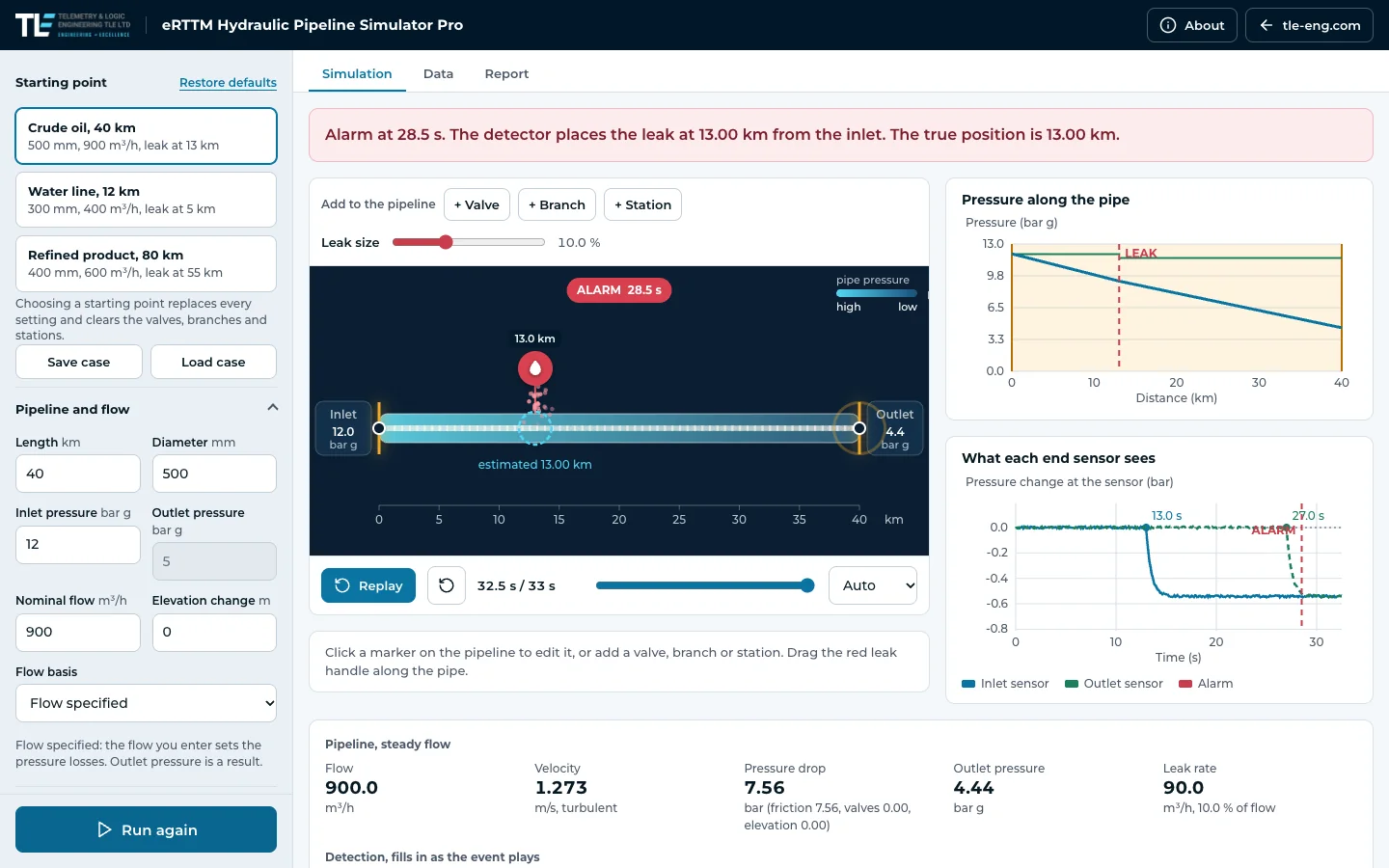
Set the length, diameter, flow and pressures, add valves, branches and stations, then drag the leak into place and press Run. The simulator calculates the pressure profile and plays the leak event: the pressure wave travelling each way, when each end sensor sees it, when the alarm is raised and where the detector places the leak.
- Drag the leak, valves and branches along the pipe and see the pressure profile change.
- Compare what the inlet and outlet sensors measure as the wave passes.
- Save a case file or print a report of the run.
Runs in your browser. Nothing to install.
PMS Compared with SCADA, LDS
and Hydraulic Simulation
The key distinction: SCADA primarily monitors and supervises operations; hydraulic simulation predicts pipeline behavior; an LDS identifies suspected leaks; and a PMS integrates operational information and engineering analysis to help manage the pipeline as a whole.
Choose a system to highlight its column.
| Capability | SCADA | Hydraulic simulation | LDS | PMS |
|---|---|---|---|---|
| Real-time instrument monitoring | Core function | Optional integration | Requires measurements | Usually integrated |
| PLC/RTU communications | Core function or interface | Usually external | Usually external | Integrated or interfaced |
| Steady-state hydraulic calculations | Not usually a core function | Core function | Supporting function | Often available |
| Transient hydraulic simulation | Not usually a core function | Advanced capability | Core to RTTM-based LDS | May be integrated |
| Leak detection | May display alarms | May support modelling | Core function | Integrated or interfaced |
| Leak localization | Not usually a core function | Possible with suitable models | Method-dependent | May be available |
| Operational optimization | Limited or application-dependent | Supports studies | Not usually a core function | May be available |
| Historical trends and reports | Core function | Depends on the product | Event-focused | Integrated or interfaced |
| Sensitivity studies | Not usually a core function | Advanced capability | Useful for tuning | May be available |
| Network-wide operational decision support | Limited without additional applications | Engineering-focused | Leak-focused | Central purpose |
The table describes typical roles, not strict product boundaries. Some modern SCADA and simulation platforms already include many of these capabilities.
Pipeline Management Systems:
Common Questions
Straight answers on what a pipeline management system is, what it does and where it sits alongside SCADA, leak detection and integrity management.
What is a pipeline management system (PMS)?
A Pipeline Management System (PMS) is an integrated software platform used to monitor, manage, analyze, optimize, and improve the safe and efficient operation of pipeline networks transporting natural gas, crude oil, refined petroleum products, water, and other fluids. It can integrate hydraulic simulation, real-time operational monitoring, leak detection, equipment monitoring, alarm management, and operational decision support into one platform.
Does a PMS replace SCADA?
Not necessarily. A PMS can operate as a higher-level analytical platform integrated with an existing SCADA system. SCADA primarily monitors and supervises operations, while a PMS integrates operational information and engineering analysis to help manage the pipeline as a whole.
What functions can a pipeline management system include?
A comprehensive PMS can include real-time pipeline monitoring, hydraulic simulation and analysis, leak detection and localization, operational optimization, alarm and event management, and pipeline integrity and maintenance support. Which of them a project receives depends on its scope and the modules implemented.
How does a PMS detect leaks?
A PMS may incorporate a leak detection system (LDS) or interface with a separate one. Possible methods include mass balance, volume balance, real-time transient model (RTTM), pressure-wave detection, statistical analysis and fibre-optic leak detection, and a comprehensive platform can combine several methods to improve detection reliability. Leak detection does not automatically mean the system can identify every leak or calculate its location accurately: performance depends on pipeline conditions, instrument quality, model calibration, communications, and the detection method.
What is the difference between a PMS and a leak detection system?
A leak detection system (LDS) identifies suspected leaks, while a PMS integrates operational information and engineering analysis to help manage the pipeline as a whole. A PMS may incorporate an LDS or interface with a separate one.
Can a PMS show whether we can increase pipeline throughput?
An appropriately configured PMS can simulate proposed operating conditions and calculate the resulting pressures, flow distribution, and other relevant variables. For example, it can test whether natural gas throughput can increase from 20 to 25 million standard cubic metres per day without exceeding the pipeline’s allowable operating pressure. The result is only as reliable as the model, input data, boundary conditions, and engineering assumptions.
Does a PMS replace a pipeline integrity management system (PIMS)?
Not automatically. A PMS can support integrity management by monitoring operating pressure against allowable limits, tracking pressure cycles and transient events, and recording historical operating conditions. Integrity assessments, corrosion modelling, geotechnical analysis, and regulatory compliance may require separate specialist modules.
How do I get a pipeline management system from TLE?
Every project is unique. Contact TLE’s technical specialists to design a system that fits your operational vision. Contact our team
From our engineers
Pipeline leak detection methods compared
How mass balance, RTTM, statistical and pressure-wave methods differ, and why high-consequence lines pair them with external sensing.
API RP 1130, API RP 1175 and 49 CFR 195.444
What each document covers, how they fit together and what to evidence.
RTTM vs fibre optic leak detection
What each method sees, where each is blind, and when to use both.

Let our experts help you build the right solution
Connect with our technical specialists today to design a system that fits your operational vision.