Key takeaways
- Distributed fibre optic sensing uses the cable itself as the sensor, so one fibre can monitor tens of kilometres continuously.
- DAS listens for vibration, DTS measures temperature and DSS measures strain. Each relies on a different light-scattering effect.
- Together they detect third-party interference, leaks, fires and ground movement along the pipeline route.
- Cable placement, fibre type and alarm software decide how well a system performs in the field.
How one cable becomes thousands of sensors
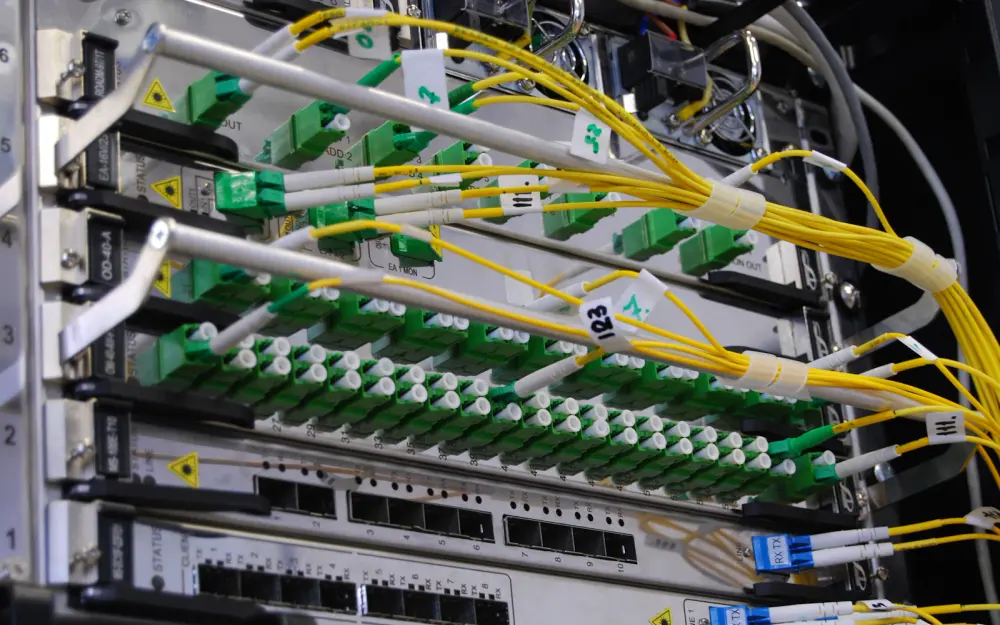
A distributed fibre optic sensing system has two parts: a standard optical cable laid along the asset, and an instrument called an interrogator at one end. The interrogator sends short pulses of laser light into the fibre. As the light travels, a tiny fraction is scattered back toward the instrument from every point along the glass. The time the backscatter takes to return tells the system where it came from, in the same way radar measures distance, and changes in its character tell the system what is happening there.
The result is a continuous line of measurement points, spaced a few metres apart, along the whole length of the cable. Nothing in the field needs power or electronics, and the glass is unaffected by electromagnetic interference, which suits pipeline corridors that run beside power lines or through electrically noisy sites.
Which property of the scattered light you analyse decides what you can measure. Three techniques are used on pipelines.
DAS, DTS and DSS: three measurements from the same type of cable
DAS: distributed acoustic sensing
DAS analyses Rayleigh backscatter. Vibration or sound reaching the cable slightly changes the light scattered back from that section, so the system can hear what is happening along the route. On a pipeline it detects excavation and machinery near the right of way, the acoustic signature of fluid escaping from a leak, and the passage of vehicles and people. It can also follow an inspection tool as it moves through the line. DAS reacts in real time, which makes it the main tool for catching third-party interference.
DTS: distributed temperature sensing
DTS analyses Raman backscatter, whose intensity depends on the temperature of the glass. The result is a temperature profile along the whole route, refreshed over seconds to minutes. Leaks change local temperature: escaping pressurised gas cools its surroundings as it expands, and released liquid product can be warmer or cooler than the ground. DTS also flags hot spots and fires. It measures slowly changing conditions precisely rather than fast events.
DSS: distributed strain sensing
DSS analyses Brillouin backscatter, whose frequency shifts with both strain and temperature in the fibre. By separating the two, it tracks how the cable, and the pipe or ground it is coupled to, is being stretched or compressed. That makes it suited to slow geotechnical hazards such as landslides, settlement and subsidence, and to monitoring pipe stress. It depends on good mechanical coupling between the cable and what it is measuring.
| Technique | Measures | Scattering effect | Typical pipeline uses |
|---|---|---|---|
| DAS | Vibration and sound | Rayleigh | Digging near the line, leak noise, tracking inspection tools |
| DTS | Temperature | Raman | Leak-related temperature change, hot spots, fire |
| DSS | Strain (and temperature) | Brillouin | Ground movement, settlement, pipe stress |
What fibre sensing detects along a pipeline
Run together, the three techniques cover the main threats to a buried or exposed pipeline:
- Third-party interference. Excavators, drilling and manual digging near the corridor, detected as they start rather than after damage is done.
- Leaks. The acoustic noise of a release (DAS) and the temperature change around it (DTS), each pointing to a position along the route.
- Ground movement. Strain building up on a section of pipe or cable before it fails (DSS).
- Thermal events. Hot spots and fires near the route or on the cable.
Where two measurements agree, for example vibration and a temperature change at the same chainage, the alarm carries more weight. Combining them is one of the main reasons to run several techniques on one cable.
Installation: what decides performance in the field
Fibre sensing is only as good as its coupling to the thing being sensed. A few design choices matter more than the choice of instrument:
- Cable route and distance from the pipe. Cable laid close to the pipe, ideally in the same trench, picks up more of what happens to the asset.
- Coupling. DSS needs the cable mechanically bonded to the pipe or soil. DAS and DTS tolerate looser coupling but still benefit from consistent burial.
- Fibre type. DTS commonly uses multimode fibre, while DAS and DSS use single-mode. A multi-fibre cable can carry both types, so one cable can serve all three techniques.
- Existing cables. Spare fibres in a telecommunications cable along the route can sometimes carry DAS without a new installation, subject to the cable’s condition and routing. Where the cable comes from is also the biggest swing factor in project cost, which we cover in DAS pipeline monitoring cost.
- Reach. Splices, connectors and fibre quality all take light away. Long routes are covered by placing interrogators at stations along the way.
From signal to alarm: why software matters
A DAS system produces a very large amount of data. Turning it into a useful alarm means telling a person digging from a truck passing, wind, rain or a nearby road, and doing so under the conditions of your specific route. Good systems classify signatures, learn what normal looks like on each section, and report events against the pipeline’s own chainage so the control room knows where to send someone. Alarms should arrive in the SCADA environment operators already use, with clear response procedures behind them.
Treat commissioning and tuning as part of the project, not an afterthought. Site-specific noise sources are the usual cause of nuisance alarms.
Where fibre sensing fits alongside conventional leak detection
Fibre sensing does not replace flow-based leak detection. Computational pipeline monitoring uses flow, pressure and temperature data to account for product along the whole line. Fibre sensing adds what CPM cannot provide: detection of excavation before a leak exists, a precise location from a physical sensor, and coverage when the line is shut in. The two are complementary, which is why we design them together on high-consequence lines. Our guide to pipeline leak detection methods compares the internal options in detail, and RTTM vs fibre optic leak detection sets the two approaches side by side.
Beyond pipelines
The same cable-as-sensor approach is used for power cable temperature monitoring, perimeter security around critical sites, railways and tunnels. We apply it to perimeter security with fibre optic sensing, where a buried or fence-mounted fibre detects intrusion along a boundary. See our fibre optic sensing page for the systems we supply, or talk to our team about a route you need to monitor.
Frequently asked questions
How far can one interrogator monitor?
Ranges of tens of kilometres per channel are typical, depending on the technique, the fibre quality and the resolution you need. Longer pipelines are covered by placing interrogators at intervals, often at existing stations, so each unit monitors the stretch on either side.
Can one cable provide DAS, DTS and DSS?
Yes, if it contains enough fibres of the right types. Each interrogator connects to its own fibre, and DTS often uses multimode fibre while DAS and DSS use single-mode. A hybrid cable therefore lets one installation serve all three.
Does fibre optic sensing replace leak detection software?
No. It complements it. Software methods account for product along the line using flow and pressure data, while fibre sensing detects third-party interference and leaks directly, with a location, along the cable route. Using both gives redundancy.
Does fibre optic sensing need power along the route?
No. The fibre is passive. Power is needed only at the interrogator and for any communications equipment at stations.